A brief history
Amyl nitrite was first produced in 1844, but it wasn’t until the 1860’s that it was used medically to treat angina (chest pain) as it caused a rapid expansion of blood vessels (vasodilation; the widening of blood vessels caused by the relaxation of tiny muscles in their walls) instantly lowering blood pressure, easing strain on the heart, and relieving an angina attack in seconds. The liquid was sealed in small glass capsules that patients crushed when they needed to inhale the vapours. When crushed, they made a popping sound, giving them their common name. Patients also reported pleasant side effects: a warm flush, a dizzying head rush, and a feeling of mild euphoria.
For the better part of a hundred years, poppers lived a relatively quiet life in the world of medicine with pharmacists across the globe stockking the little glass “poppers”, prescribing them for a range of other ailments where vasodilation might help, from relieving sea sickness to treating cyanide poisoning.
This same vasodilation that helped heart patients also relaxes all smooth muscles in the body, including the anal sphincter (arse hole muscle). This makes getting fucked easier and entry into the arse less painful, and, for many, a lot more pleasurable. The rush can intensify orgasms, creating a powerful combination that has embedded poppers’ place in gay culture and queer bedrooms everywhere.
Because amyl nitrite was a prescription drug, chemists created legal workarounds by slightly tweaking the molecule and marketing them as ‘video head cleaners,’ ‘leather polish,’ or ‘room odorizers’. When the US restricted amyl nitrite to prescription-only use in 1969, gay men changed to producing butyl nitrite as a freely available alternative. By the 1970s, poppers had become a permanent fixture of gay clubs on both sides of the Atlantic.
Poppers arrived on the UK gay scene in the 1970s and have never really left. In 2024, the UK’s Advisory Council on the Misuse of Drugs secured a legal exemption for poppers, recognising their use as a sex aid by gay men.
Desired highs
Poppers produce an almost instant rush: a warm, heady, lightheaded sensation lasting one to three minutes. Blood vessels dilate, the heart rate rises, and smooth muscle relaxes throughout the body, including the arse. This combination intensifies physical sensation during sex, heightens arousal, and makes receptive anal penetration easier and more pleasurable.
How they’re taken
 Once the bottle is opened, the liquid evaporates and the vapour is inhaled directly, usually in one or two short sniffs through the nose or mouth. The effects are felt within 15 seconds and can last up to three minutes. Evolving from the humble 10ml bottle you can also purchase adaptors: one to screw on two 10ml bottles, and another to screw onto a bottle with openings designed for each nostril. It seems a tad greedy but who are we to judge!
How they come
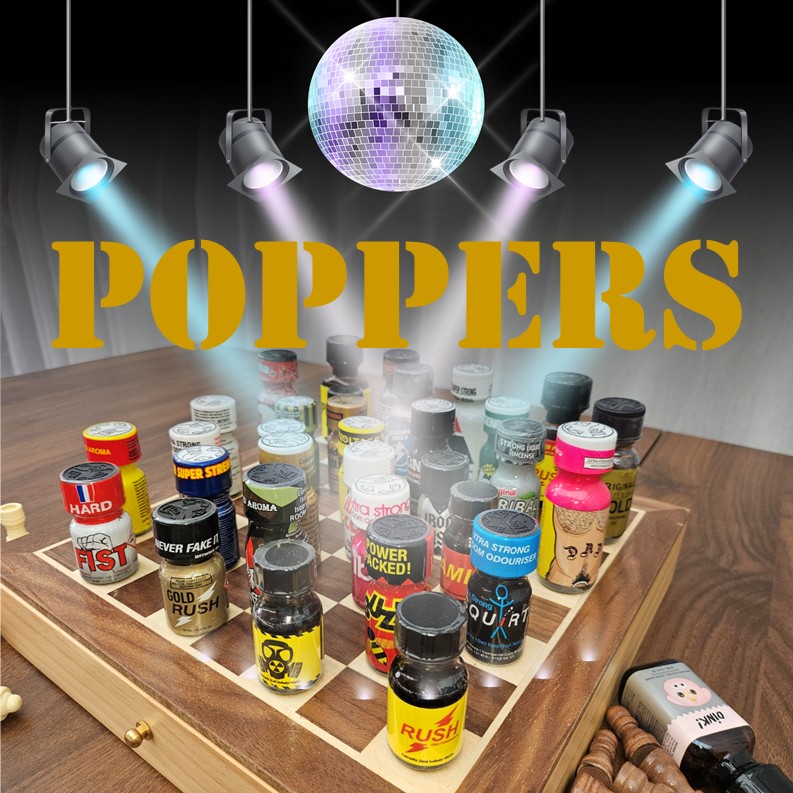
Alkyl nitrites are yellowy-clear liquids usually sold in small, brown glass bottles. You will find them in sex shops, online, or at gay venues, often labelled as room aromas or leather cleaner. Amyl nitrite has the longest safety record, Isobutyl nitrite is classified as a carcinogen in the EU, Isopropyl nitrite is now the most common formula in the UK following various regulatory changes.
Types
Poppers’ formula varies by brand and by country. However, The UK Advisory Council on the Misuse of Drugs says evidence comparing the effects and toxicity of individual alkyl nitrites is extremely limited. Human pharmacological information (how medicines work in the human body) is mainly available for amyl nitrite, and while the different nitrites genuinely have different volatility, which could affect how quickly vapour is delivered, descriptions such as “silky,” “refined,” “premium,” “clean,” “balanced” and “full-bodied” are subjective sales language, and not established pharmacology. None of these descriptions establishes that one formula is safer. All alkyl nitrites can cause headache, dizziness, low blood pressure, and fainting.
Down the rabbit hole
Strength differs by chemical type, not by brand. Perhaps an odd analogy, but a chemical’s boiling point (and evaporation) gives a rough indication of its instability and can be in indication for the speed and intensity of the ‘hit’. A lower boiling point means faster evaporation and therfore a faster ‘hit’:
- Propyl nitrite: boiling point ~46–48°C. Fast-acting, on the more intense end of the scale
- Isobutyl nitrite: no clean boiling point figure is widely published, but chemically similar in volatility to butyl. It has been banned across the EU since 2007 as a carcinogen, and therefore should not legally be in any UK products, though it still occasionally turns up in analysis of seized samples
- Amyl nitrite/ Pentyl nitrite: these are essentially the same thing. “Amyl” is the old common name; “pentyl” is the correct chemical name for the same five-carbon chain. Boiling point ~96–99°C, meaning it evaporates more slowly than propyl or isobutyl, generally regarded as ‘gentler’ and slower-onset
- Hexyl nitrite: a six-carbon chain, so by the general pattern (longer chain, higher boiling point, slower evaporation) it would be expected to be milder and slower still. Solid, specific human-use data on hexyl nitrite is scarce. It’s far less studied and far less common in UK products than the others
- Pentyl Nitrite with Butanol: this is likely a formulation rather than a separate chemical: butanol (an alcohol) added as a diluent or stabiliser to a pentyl nitrite base. This would generally mean a lower concentration of the active nitrite per bottle, which could make it feel weaker in practice — but strength would depend entirely on the ratio, which isn’t something a consumer bottle reliably discloses.
Labelling accuracy
Labelling accuracy has been shown to be unreliable. Lab analysis of poppers bottles has found that what is declared on the label often doesn’t match what’s actually inside. So this list may describe what’s claimed on packaging rather than what’s chemically verified in UK retail products. In one analysis of 76 poppers products, 51% differed from their declared nitrite, and 54% contained more than one alkyl nitrite. UK forensic detections reported to the Advisory Council on the Misuse of Drugs (ACMD) were overwhelmingly isopropyl nitrite, with very few confirmed amyl or isopentyl products.
The take-a-way: different alkyl nitrites have different volatility and may feel somewhat different, but reliable human comparisons are lacking. Product composition, purity and concentration are not independently guaranteed, and individual responses vary.*
Why Sniffing Drugs Changes Your Butthole | AsapSCIENCE | 8 Jul 2021 | 5m 52s
Interactions and complications
After inhaling poppers your blood pressure drops fast and dizziness is common. If you feel faint, nauseous, or develop a severe headache, stop immediately and get some fresh air. You should not use poppers if you have heart problems, low blood pressure, anaemia, or glaucoma. You must avoid using them if you also use erectile dysfunction medication, Viagra (sildenafil), Cialis (tadalafil), Levitra (vardenafil), as this combination can be fatal. Both poppers and these drugs lower blood pressure through related mechanisms and when taken together, the drop can be catastrophic: severe hypotension, stroke, cardiac arrest, death. This is not a theoretical risk. Do not mix them.
Regular use can cause persistent headaches and skin rashes or burns around the nose and mouth from contact with the liquid. Isopropyl nitrite in particular is linked to poppers maculopathy, a form of retinal damage that can cause permanent vision loss. Methemoglobinemia, a blood disorder impairing oxygen transport, is rare but serious. Blue lips, confusion, or shortness of breath after using poppers require an immediate call to 999.
Storage and “going off”
Fridge storage is contested rather than clearly true or false. Cold slows evaporation, but repeated temperature swings between the fridge and you room can accelerate breakdown. Most sources recommend somewhere cool, dark, and stable instead, eg: a drawer or cupboard. Air, light, heat, and moisture degrade the nitrite over time, changing the smell, sometimes discolouring the liquid, and weakening the hit. If it smells noticeably different or looks discoloured, bin it.
Learning the hard way
- Be careful when using poppers with lubed up fingers as bottles get very slippy
- Screwing the lid back on with lubed up fingers is a nightmare
- Always screw the lid on tightly when done. Then check
- Double/ triple bag poppers when travelling as they can leak everywhere
Swallowing, skin contact and flammability
- You should never swallow poppers as the the liquid is toxic and can be fatal if ingested
- You should also avoid skin contact as it causes chemical burns which can be nasty
- Keep them away from naked flames as the liquid is highly flammable
GMHC and the campaign to prevent a ban on poppers
In August 2015, the Gay Men’s Health Collective (GMHC) provided evidence opposing the proposed inclusion of poppers (more accurately, alkyl nitrites) in the Psychoactive Substances Bill. GMHC’s evidence was supplied to the drugs charity Release and incorporated into a joint submission by Release and Transform to the House of Commons Home Affairs Committee.
We argued that prohibiting the sale of poppers would not prevent their use. Instead, it could push the market underground and introduce gay men who had previously only used poppers to potentially more dangerous drugs, including GHB/ GBL, ketamine and stimulants. We also warned that removing poppers could increase the occurance of sexual injuries and the transmission of HIV, hepatitis C and other sexually transmitted infections. Poppers are widely used by gay men to relax muscles during anal sex, reducing the potential for tearing or damage when used alongside lubricant.
The Home Affairs Committee explicitly accepted our evidence, alongside evidence from the National AIDS Trust and Professor Les Iversen. Its October 2015 report recommended that poppers should not be banned. Our warning was subsequently cited during the House of Commons debate in January 2016, including by Conservative MP Crispin Blunt.
Poppers were ultimately not prohibited under the Psychoactive Substances Act 2016. Our intervention formed part of the parliamentary evidence demonstrating why drug policy affecting gay men must be informed by sexual-health realities, harm reduction and the experiences of the communities most directly affected.
More
WikipediaRelease
KFX
News and articles
Poppers, the Politics of Exemption and the Characteristics of Poppers Users | English Festival Study, 2014–23 | The British Journal of Criminology (Oxford Academic) | Date: 27 Sep 2024New research into poppers highlights problematic proposed drugs policy | University of Liverpool/ Aston University | 23 Sep 2024
Explainer: the science of alkyl nitrites aka poppers | Chemistry World | 16 Apr 2021
Poppers in the UK: a brief guide to the battle over legality | Dazed | 13 Aug 2020
Poppers can now be sold in pharmacies, but getting them might not be so easy | The Conversation | 11 Feb 2020
New chemical composition of ‘poppers’ linked to retinal damage | British Journal of Ophthalmology/ ScienceDaily | 10 Apr 2017
Weekly Dose: amyl started as a poison antidote, now a common party drug | The Conversation | 22 Sep 2016
Ministers decide not to ban ‘poppers’ | BBC News | 23 Mar 2016
Crispin Blunt’s poppers speech: a brave acknowledgment of awkward truths | The Conversation | 21 Jan 2016
Poppers manufacturer ‘will fight’ legal high ban | BBC News | 3 Feb 2016
Poppers Can’t Fall Under Legal Highs Ban As They’re Not Psychoactive, Experts Tell Government | HuffPost UK | 16 Mar 2016
Nick Clegg: let poppers manufacturers keep operating during review | The Guardian | 10 Mar 2016
The poppers ban: will it criminalise gay users? | The Guardian | 7 Mar 2016
Tory MP Crispin Blunt ‘outs himself’ as popper user | BBC News | 20 Jan 2016
* Sources: 1) Vogt, S.B., et al. (2015), cited in Advisory Council on the Misuse of Drugs, Alkyl Nitrites (“Poppers”): Updated Harms Assessment and Consideration of Exemption from the Psychoactive Substances Act 2016, 2024, Section 9.1, p.10. 2) Advisory Council on the Misuse of Drugs, Alkyl Nitrites (“Poppers”): Updated Harms Assessment and Consideration of Exemption from the Psychoactive Substances Act 2016, 2024, Section 9.3 and Annex C, pp.10, 31.