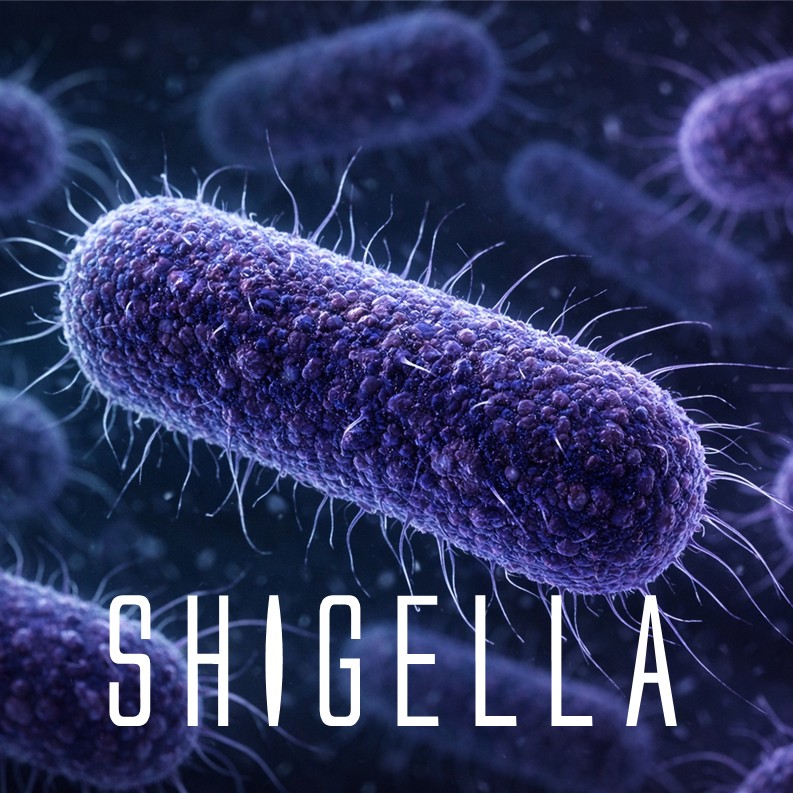
Shigella is a bacterial gut infection (Shigellosis). It causes diarrhoea: the shits from hell, often bloody, painful cramps, and fever. Can be more severe and longer-lasting if drug-resistant; and sometimes needs hospital care.
We lurve our rimming and arse play but, if present, shigella spreads efficiently through sex, often without us realising. Notably, drug-resistant Shigella is increasing among gay men in the UK, and across Europe with some strains now resistant to multiple antibiotics making it harder to treat.
So, know the risks, be safer, pause those hook-ups if you’re if unwell, and test early.
How do you get it?
- Tiny amounts of infected shit (faeces) entering the mouth.
- Oral-anal sex (rimming).
- Fingering/ fisting, then touching the mouth.
- Shared sex toys, which includes cocks.
- Increased risk during longer sessions, heavier sex, multiple partners
Symptoms
- Diarrhoea (often watery, sometimes with blood or mucus)
- Stomach cramps and pain
- Fever (38°C / 100.4°F or higher)
- Feeling unwell (tired, achy)
- Nausea or vomiting (less common)
- Watch for blood in poo, dehydration, or severe pain.
Temperature guide
- A high temperature (fever) is 38°C / 100.4°F or above.
- 38–39°C (100.4–102.2°F): common with infections like Shigella.
- 39°C+ (102.2°F+): more significant/ monitor closely.
- 40°C+ (104°F+), or fever with severe symptoms (dehydration, confusion, severe pain). Get urgent medical care!
Diagnosis and treatment
- Poo (stool) sample/ swab test confirms and checks antibiotic resistance.
Sexual health clinic or GP. - Antibiotics only if prescribed (based on results).
eg: Azithromycin, Ciprofloxacin, Ceftriaxone. - Seek care urgently if severe symptoms (blood, dehydration, worsening pain).
- Some cases clear without antibiotics.
How do you reduce the risk?
- Wash hands, genitals, anus before/after sex.
- Use barriers for rimming (e.g. dental dams).
- Use gloves for fingering/fisting; change between partners.
- Clean sex toys between uses.
- Avoid sex if you or a partner has diarrhoea, and for 7–14 days after symptoms stop.
Why is it antibiotic-resistant?
- Repeated/incorrect antibiotic use drives resistance.
- Strains circulate and share resistance within sexual networks.
- Some no longer respond to first-line antibiotics.
- This makes infections harder to treat and slower to clear.
Shigella: the gift that keeps giving
- It takes very little to infect you, as few as 10–100 bacteria can cause illness, so it spreads very easily.
Comparison: chlamydia and gonorrhoea: 1,000–1000, 000 bacteria - Genetically, it’s very closely related to Escherichia coli (E. coli).
- It’s acid-resistant so survives stomach acid, so more bacteria reach the gut alive.
- Invades and spreads through the gut lining, attacking intestinal cells and moves cell-to-cell, driving inflammation, cramps, bleeding, and a strong immune response.
- It’s ‘built’ for close contact so spreads quickly in tight/ social/ fuck bud/ sex networks, so outbreaks can cluster.
- If you’ve been travelling, it can misread as a “holiday bug”, “food poisoning” or “traveller’s diarrhoea”). Ask yourself: have you had sex?
- It can hang around after symptoms stop so you may still pass it on for days or weeks after you feel better.
- You can also have it without knowing. Some have mild or no symptoms but can still pass it on.
More
Shigella | WikipediaShigella | PDF | Public Health England
Dysentery | NHS Increase in drug-resistant Shigella cases among gay and bisexual men | GOV.UK | 26 Mar 2026
Warning after rise in extremely drug-resistant Shigella | GOV.UK | 21 Dec 2023
Spread of multidrug-resistant Shigella in EU/EEA among gay, bisexual and other men who have sex with men | EATG | 20 Jul 2023
Outbreak of sexually transmitted, extensively drug-resistant Shigella sonnei in the UK, 2021–22: a descriptive epidemiological study | The Lancet | Oct 2022
Rise in extremely drug-resistant Shigella in gay and bisexual men | GOV.UK | 27 Jan 2022
Shigella is the STI you’ve probably never heard of – and it’s on the rise among gay and bi men | Pink News | 29 Jul 2021
Shigella: guidance, data and analysis | GOV.UK | 4 Jan 2019 Analysis of WW1 Shigella strain | The Lancet | 6 Nov 2014 | 2m 27s